The New Creative AI Frontier Why Human Creativity Still Matters

By Scott Price
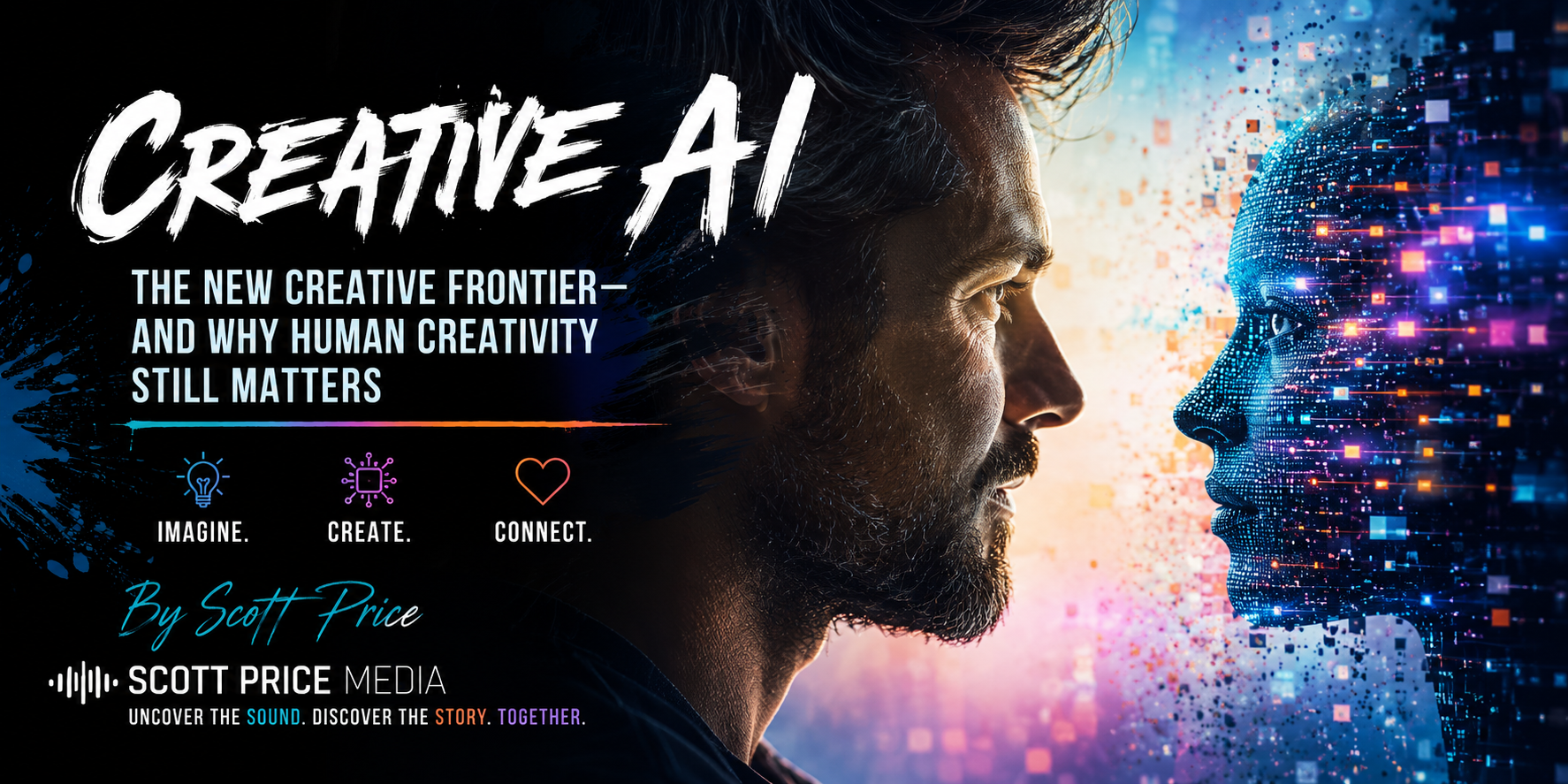
Artificial intelligence is changing the creative world at a remarkable pace.
Not long ago, creating a professional looking image, developing a video concept, producing music, designing a website or publishing a polished article often required specialized software, expensive equipment, technical knowledge, or an entire team of people.
Today, many of those barriers are beginning to disappear.
With the right AI tools, an idea can move from a thought in someone’s head to something they can see, hear, edit and develop in a matter of minutes.
That is exciting. Especially, for a guy like me!
But it also raises an important question.
If artificial intelligence can create so much, what does it mean to be a creator?
I don’t believe the answer is that AI is going to replace human creativity.
I believe we’re entering a period where the people who understand how to combine human imagination with artificial intelligence are going to have an extraordinary creative advantage.
And that is what makes Creative AI so interesting to me.
AI Isn’t the Artist. The Human Still Matters.
There’s an easy mistake to make when looking at something produced with artificial intelligence.
We see a beautiful image, an impressive video, a piece of music or a well written passage and say, “AI created that.”
In one sense, that’s true.
But I think it misses something important about the creativity behind the AI.
Creativity isn’t simply the ability to produce an image, write a paragraph or generate a piece of music. Creativity begins with the decision to make something in the first place and, more importantly, with understanding why it should exist and knowledge on how to make it.
A photographer doesn’t simply take a picture because a camera is capable of doing it. A musician doesn’t write a song simply because they know how to play an instrument. A writer doesn’t tell a story simply because a keyboard is sitting in front of them.
There is an idea, an observation, an experience and a feeling behind the work.
That human intention still matters.
AI can help us explore an idea, develop it and bring it to life, but I don’t believe we should confuse the ability to generate something with the ability to understand why that something matters.
That distinction is going to become increasingly important down the road.
Creative AI Has Already Moved Beyond the Experiment
This isn’t some distant vision of the future anymore. Creative AI is already becoming part of everyday creative work.
Adobe’s 2026 Creators’ Toolkit Report, based on a survey of more than 16,000 creators across eight countries, found that 75% of creators using creative AI describe it as integrated or essential to their workflow, while 87% say it has accelerated the growth of their business or audience. Even more telling, 85% believe the final creative decision should remain with the creator. (Adobe Newsroom)
Those numbers tell me something important. The conversation is moving beyond “Should creators use AI?”
Now we are asking a different question:
“How should creators use AI without losing what makes their work their own?”
That’s a much more interesting conversation to me.
The Creative Advantage Is Changing
Every major technological advancement has changed the creative process.
Digital cameras changed photography. Desktop publishing transformed graphic design. Digital audio changed music production. Nonlinear editing transformed video production, and the internet completely changed how writers, photographers, musicians and publishers could reach an audience.
AI is another step in that evolution.
But there is something different about this particular transition.
AI can dramatically reduce the amount of time required to produce a first draft or explore an idea.
That means the ability to simply produce something may become less valuable as a competitive advantage.
If everyone has access to tools capable of producing impressive images, videos, articles and designs, then simply having access to the technology won’t make someone stand out.
The creative advantage starts moving toward the person using the technology.
Adobe’s 2026 research reflects this shift, finding that 81% of surveyed creators believe human judgment remains essential to creative taste, while 57% say AI-generated outputs still require moderate or extensive editing before they’re ready to share. (Adobe Newsroom)
That makes perfect sense to me.
AI can give us possibilities.
We just have to decide which possibilities are worth pursuing.
From Creator to Creative Director
One of the biggest changes AI may bring to creative work is a change in our role.
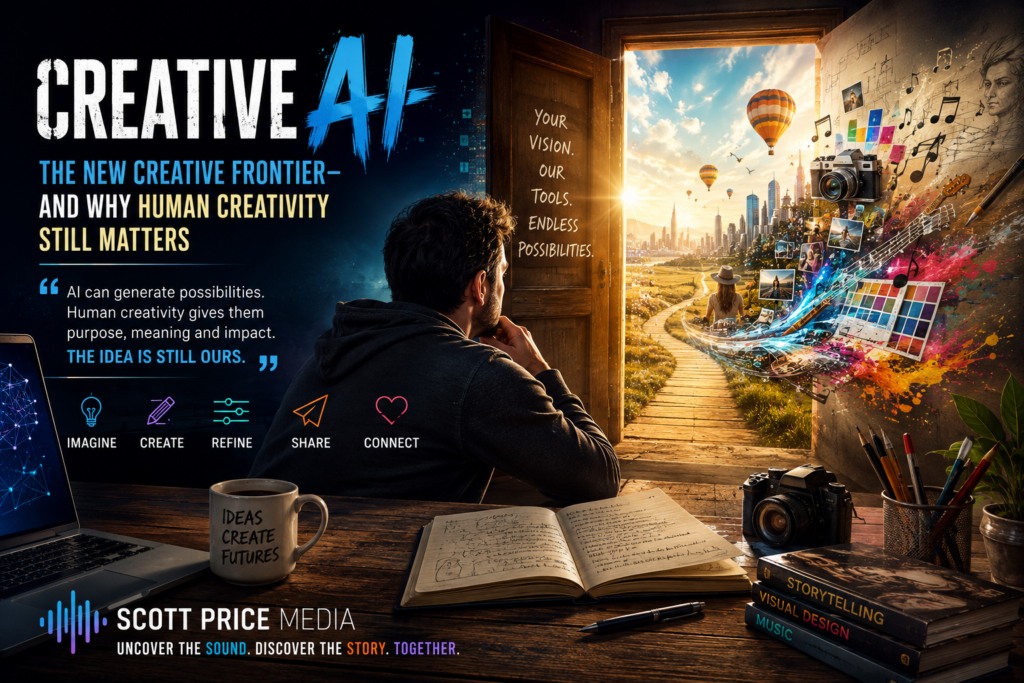
Instead of spending all of our time performing every technical step manually, we can increasingly become the creative director of our own ideas.
Imagine starting with an idea for a feature story.
You could use AI to brainstorm different approaches, develop an outline, explore visual concepts, create supporting artwork, refine a headline, organize research and prepare different versions for different platforms.
The technology can help with many of those tasks.
But someone still has to sit back and ask:
Does this actually work?
Does it communicate the idea?
Does it feel authentic?
Does it sound like me?
Is the information accurate?
Is the image appropriate?
Is this something worth publishing?
Those questions require judgment.
And I suspect that judgment is going to become one of the most valuable creative skills of the AI era.
More Content Doesn’t Mean Better Content
There is another issue that I think deserves considerably more attention.
AI makes it incredibly easy to create more.
But the internet doesn’t necessarily need more content.
It needs better content.
We already live in a world where people are surrounded by information from the moment they wake up until the moment they put their phones down at night. Social media moves quickly, news cycles never seem to stop, and creators are competing for attention in an increasingly crowded environment.
If AI simply allows us to produce enormous amounts of generic material, we haven’t necessarily made the world more creative.
We’ve just made the noise louder.
I would much rather see AI used to help someone develop an idea they genuinely care about, tell a story they couldn’t previously tell, experiment with something new or bring a unique perspective to an audience.
The objective shouldn’t be to create more noise.
It should be to create something worth paying attention to.
The Human Element May Become More Valuable, Not Less
There is an interesting paradox developing with AI.
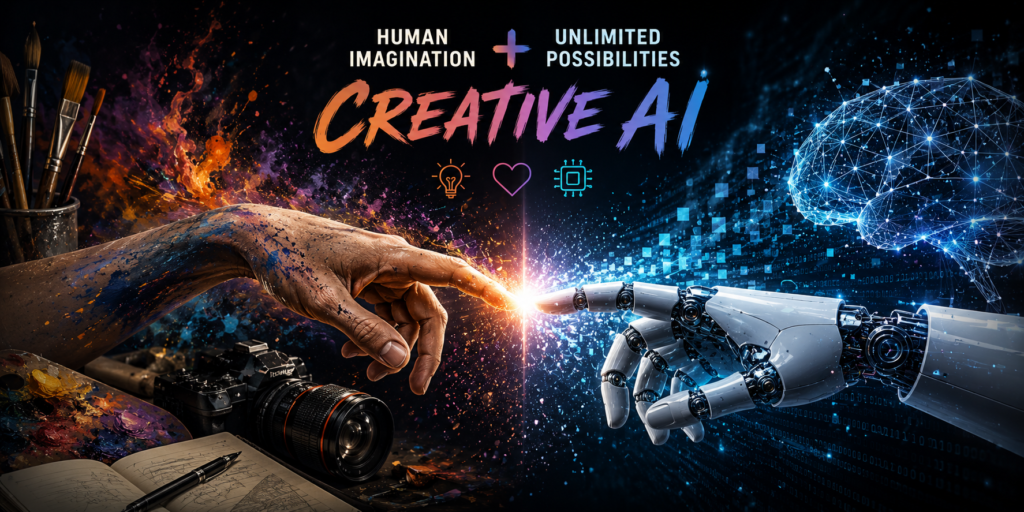
The better machines become at producing technically impressive work, the more important human authenticity may become.
A technically perfect photograph isn’t necessarily a meaningful photograph.
A beautifully produced song isn’t automatically a memorable song.
An article can contain every relevant fact and still feel completely lifeless.
What makes creative work connect with people is often the human experience behind it.
The decisions made by the creator, the observations they’ve collected over time, the things they’ve learned, the mistakes they’ve made, the places they’ve been and the way they see the world all influence the work they produce.
AI doesn’t erase those experiences.
If anything, it gives us another way to express them.
That’s why I don’t see Creative AI as a competition between humans and machines.
I see it as an opportunity to give human creativity a larger canvas.
But Creative AI Comes With Responsibility
This is where enthusiasm for the technology needs to be balanced with common sense.
There are legitimate questions surrounding copyright, ownership, consent, artistic identity and the use of creative works in AI training.
Those questions aren’t going away.
The U.S. Copyright Office has already concluded that AI-assisted work can qualify for copyright protection when there is sufficient human creativity involved, while simply providing prompts to an AI system does not, by itself, establish the necessary human authorship. The Office also continues to examine questions surrounding the use of copyrighted works to train AI systems. (U.S. Copyright Office)
That is an important distinction for creators to understand.
Using AI as part of a creative process isn’t automatically the same thing as handing the entire creative process over to a machine.
The more meaningful question is how much human creative control went into the finished work.
That is why I believe responsible creators need to understand the tools they are using, pay attention to licensing and usage terms, respect other people’s work and think carefully about how AI-generated material is incorporated into something they publish.
The technology is moving quickly.
Our responsibility has to keep pace with it.
Authenticity Is Going to Matter
I also believe we’re going to see much more discussion about transparency.
As AI becomes more capable, audiences are going to become better at recognizing when it has been involved in the creative process.
Adobe’s 2026 research found that 85% of surveyed creators believe audience expectations around AI disclosure are either increasing or staying steady, while 90% believe it is important to be able to obtain copyright protection for work created with AI assistance. (Adobe Newsroom)
I think that’s a healthy development.
There is nothing inherently wrong with using AI to help create something.
What matters is being honest about the role it played when that information is relevant to the audience.
Trust is difficult to build and incredibly easy to lose.
Creators shouldn’t underestimate its value.
How I Think We Should Approach Creative AI
I don’t believe we should approach AI with either blind enthusiasm or blind fear. Both extremes miss the point.
Instead, I think we should learn how to use it intelligently.
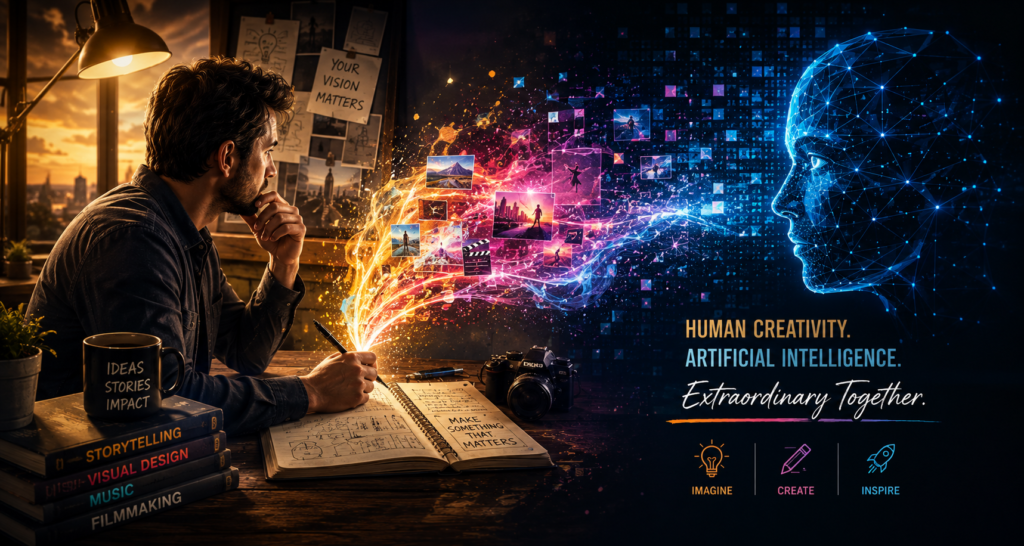
For me, that starts with putting the idea before the technology.
Don’t begin by asking what an AI tool can generate. Begin by asking what you are trying to accomplish.
Once you know that, AI can become an incredibly useful creative partner.
Use AI to explore possibilities you may not have considered or to overcome technical limitations. Use AI to experiment. Use it to help with repetitive tasks. Use it to develop rough concepts and see where they might lead.
But don’t automatically accept the first thing it gives you.
Question it. Edit it. Improve it.
And most importantly, make sure the finished work still reflects the reason you created it in the first place.
Don’t Compete With AI. Learn How to Direct It.
I don’t think the future belongs to people who completely reject artificial intelligence.
I also don’t think it belongs to people who hand their creativity over to AI and simply accept whatever comes back.
I believe the greatest opportunities will belong to people who learn how to direct the technology while maintaining control of the creative vision.
That’s an important distinction.
The person who knows how to use AI isn’t necessarily more creative than everyone else.
But the person who knows what to ask for, what to reject, what to change and what to keep can potentially accomplish things that would have required far more time and resources just a few years ago.
That changes the equation.
A single person with a good idea can now experiment at a scale that previously might have required a small production team.
That’s exciting.
The Democratization of Creativity
Perhaps the most promising part of Creative AI isn’t what it can do for established professionals.
It’s what it can do for people who have always wanted to create but didn’t have access to the traditional tools.
Someone with a great story but limited design experience can begin visualizing that story.
Someone with an idea for a video but no production crew can experiment with the concept.
Someone who has never considered themselves a designer can begin exploring visual ideas.
Someone with a business idea can create prototypes before investing heavily in production.
That lowering of the barrier to entry could be one of the most significant effects of Creative AI.
But there is an important trade-off.
When more people have access to powerful creative tools, having the tools is no longer enough.
The quality of the idea matters.
The quality of the decisions matters.
And perhaps most importantly, the person behind the work matters.
The Future Belongs to Creative People Who Adapt
Technology has never stopped changing.
The creators who thrive through those changes aren’t necessarily the people who master every new tool first.
They’re the people who understand what the tools can do and then figure out how those capabilities can serve their own creative vision.
That’s how I look at Creative AI.
I don’t want technology deciding what I should create.
I want technology helping me explore what I could create.
There’s a big difference.
The first approach gives the machine the creative lead.
The second keeps the human being in the driver’s seat.
That’s where I believe we should remain.
Human Imagination + Artificial Intelligence
We’re entering one of the most interesting periods in the history of creative expression.
The technology is changing quickly, and we’re going to have difficult conversations along the way about copyright, ownership, authenticity, employment, artistic identity and what it actually means to create something.
Those conversations are necessary.
But I don’t think we should allow the legitimate concerns surrounding AI to blind us to its potential.
Used responsibly, Creative AI can give people access to creative possibilities that were previously out of reach.
It can help us experiment more.
It can help us work faster.
It can help us overcome technical barriers.
It can help one person explore ideas that might once have required an entire team.
Most importantly, it can give people another way to turn an idea into something real.
And that is where I see the opportunity.
I don’t believe the future of creativity is AI versus humans.
I believe the more interesting future is human imagination working alongside artificial intelligence.
The technology will continue to evolve.
The tools will become more capable.
The process will continue to change.
But the reason we create in the first place will remain remarkably human.
We create because we have something to say.
We create because we see something differently.
We create because an idea takes hold of us and we want to bring it into the world.
AI can help us build the canvas. It can help us explore the possibilities. It can even help us bring an idea to life.
But the vision still has to come from somewhere.
And I believe that vision will always be one of the most valuable things a creator can bring to the table.
The Bottom Line
Creative AI isn’t the end of creativity.
It may be the beginning of an entirely new chapter.
The creators who understand that distinction won’t be trying to compete with machines. They’ll be learning how to use them, challenge them, direct them and, when necessary, ignore them.
Because the goal isn’t to become better at generating content.
The goal is to become better at creating something that matters.
And that, ultimately, is still up to us.
Scott Price Media
Uncover The Sound. Discover The Story. Together.